Choosing between a swimwear factory and a trading company can have a direct impact on your unit costs, production control, and lead times. A trading company may add a sourcing or service margin to the factory’s production cost, while a direct factory relationship can give you more visibility into manufacturing and quality control. The right choice depends on your order volume, product complexity, budget, and how much support your team needs.
This guide compares the two models across the factors that matter most to buyers: pricing, MOQ, lead time, customization, and quality control. We benchmark both models on the metrics that matter: unit pricing, minimum order quantity (MOQ) requirements, lead times, and customization capabilities. The goal is to clarify the real-world trade-offs between control and convenience, helping you select a partner that aligns with your brand’s financial targets and operational capacity.

What Is a Swimwear Factory?
A swimwear factory is a specialized manufacturer that owns the machinery to produce swimwear for brands. They handle the full process from sourcing and sampling to bulk production.
A Production-Focused Organization
At its core, a swimwear factory is a manufacturer with direct production capabilities, including machinery, technical staff, sampling, and quality control resources for products such as bikinis, one-pieces, and activewear. The factory is directly involved in making the garments, although some specialized processes may still be outsourced.
A trading company, by contrast, acts as an intermediary between the brand and one or more manufacturing partners. Depending on the business model, it may source products, coordinate production, manage logistics, or combine several services into one supplier relationship.
Main Service Models: OEM, ODM, and Private Label
Most swimwear factories work with brands through three primary models: OEM, ODM, and Private Label. The main difference between them is who owns the design and how much development work the factory does.
- Original Equipment Manufacturing (OEM): The brand provides a detailed technical packet (tech pack) with all specifications, patterns, and fabric choices. The factory’s job is to manufacture this unique, proprietary design. The brand owns the final product’s intellectual property.
- Original Design Manufacturing (ODM): The factory offers a catalog of its own pre-developed styles. The brand selects a design from this library and customizes it with their own colors, prints, and logos. This approach is much faster because the core design work is already done.
- Private Label: This is the simplest model. The factory provides ready-made, unbranded swimwear. The brand just adds its own labels and packaging. It requires the least amount of development work and is a common entry point for new or smaller labels.
What Is a Swimwear Trading Company?
A swimwear trading company acts as an intermediary between brands and manufacturing partners. Depending on its business model, it may source products, coordinate custom production, manage quality checks, and handle logistics through one or more factories. Its pricing may include a markup, sourcing commission, or service fee for these services.
Core Function as a Supply Chain Intermediary
A swimwear trading company acts as a straightforward middleman. It buys finished products from various factories, adds its own margin, and resells them to brands and retailers. It doesn’t own or operate any production facilities. The entire business centers on sourcing products, consolidating orders, and managing the logistics of exporting them.
Trading companies generally make money through a markup, sourcing commission, or service fee. In a markup model, the buyer receives the trading company’s final quoted price rather than the factory’s underlying production price. The actual pricing structure depends on how the trading company manages sourcing, production, quality control, and logistics.
Key Differences from a Swimwear Factory
The core assets tell the whole story. A factory’s value is in its machinery, technical staff, and physical plant. A trading company’s main asset is its network of factory partners. The difference is mainly in where production responsibility sits: the factory manages manufacturing directly, while the trading company coordinates production through external manufacturing partners.
Factories typically manage core manufacturing activities such as pattern development, cutting, sewing, and production quality control through their own teams. Trading companies usually coordinate these activities through one or more manufacturing partners, although some may also have their own merchandising, development, or quality-control teams. For a brand, this creates a clear set of trade-offs.
- Direct Factory: Working directly with a factory gives a brand more control over the production line and clear transparency on costs. The communication channel is short and direct.
- Trading Company: Using a trading company introduces another communication layer, which can increase the risk of delays or misunderstood technical details. The buyer may also have less visibility into the manufacturing partner’s underlying production costs, depending on the trading company’s pricing model.
Premium Swimwear Manufacturing From 100 Pieces
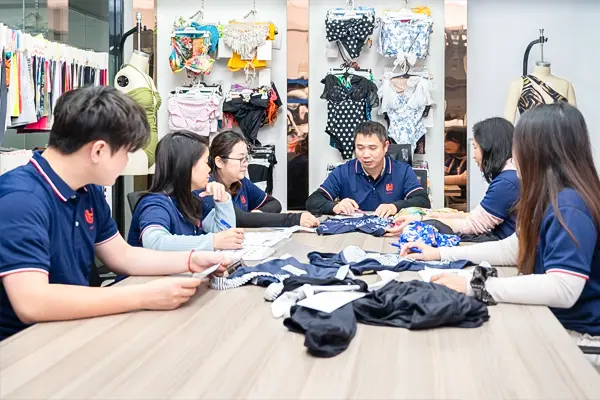
Key Differences Between Factory and Trading Company
A factory gives you direct control over production and lower costs. A trading company acts as a middleman, offering sourcing flexibility and coordination for a price.
Direct Control Over Production and Quality
A factory isn’t just a supplier; it owns and runs the production lines. This means they manage every step themselves, from cutting the fabric to the final stitch on your swimwear. You’re talking directly to the people making your product.
That direct control gives you the power to get exactly what you want. You can specify unique patterns, technical materials, and specific construction techniques, and the factory’s own team executes the OEM swimwear manufacturing process. There’s no one in the middle to misinterpret your instructions.
Pricing is also more straightforward and typically lower. Without an intermediary margin, direct factory sourcing can reduce the additional sourcing costs built into the quoted price. It can also give you a clearer line of communication with the team responsible for production.
Quality control can also be easier to verify because the buyer has a direct relationship with the manufacturing facility. Depending on the agreement, the buyer can arrange factory visits, third-party inspections, or production checks and communicate issues directly with the production team.
Sourcing Coordination and Supply Chain Flexibility
A trading company acts as a middleman. They don’t own any sewing machines or production facilities. Instead, they have a network of factories and coordinate with them to get your products made.
Their main value is flexibility, especially with Minimum Order Quantities (MOQs). They can consolidate your small order with orders from other clients to meet a factory’s large minimum requirement, giving you access to production you couldn’t get on your own.
This model also lets you source a wide variety of products through a single contact. You might need swimwear, activewear, and beach towels. A trading company can find different factories for each and manage the whole process for you.
This convenience comes at a cost. The price you pay includes the trading company’s service margin on top of what the factory charges. You are paying for their project management, sourcing, and logistics coordination.
Difference in Pricing and Cost Structure

Factory pricing reflects the costs of materials, labor, production overhead, development, and the manufacturer’s margin. A trading company may add a markup, sourcing commission, or service fee to cover its role in sourcing, coordination, quality control, and logistics.
Factory Cost Structure and Direct Pricing
When you buy directly from a factory, the price is structurally lower. You’re not paying for a middleman’s margin, just the real costs of production plus the factory’s profit. A typical FOB (Free on Board) price for swimwear is a mix of a few key cost buckets.
A swimwear factory’s FOB price typically reflects several cost components, including fabric and trims, cutting and sewing labor, printing or dyeing when required, packaging, quality control, factory overhead, and the manufacturer’s margin. The proportion of each cost varies significantly by fabric, construction, order quantity, customization, and production location.
For example, a simple stock-fabric style may have a very different cost structure from a custom-printed swimsuit using recycled fabric, specialized lining, molded cups, or complex construction.
Development costs are handled separately. Sample fees vary by factory and by the complexity of the style. Simple existing styles may require only a basic sample charge, while fully customized designs can cost more because of pattern development, special fabrics, trims, or multiple fit revisions. Some factories may credit approved sample fees against a later bulk order, but this should be confirmed during quoting.
Trading Company Pricing Models and Added Costs
A trading company’s price is simply the factory’s price with an extra layer of cost on top. This results in a higher unit cost for you, the brand. They typically use one of two models.
- Markup Model: The trading company sources the product from a factory and resells it to you at a higher price. The difference covers its sourcing, coordination, and operating costs, as well as its profit margin.
- Commission Model: The trading company acts as a sourcing agent and charges a transparent service fee, usually 3-10% of your total order value.
This extra money doesn’t go into making the garment better. It pays for the trading company’s services, like managing multiple vendors, overseeing quality, coordinating logistics, and taking on some of the financial risk of the deal.
Difference in MOQ Requirements
Factory MOQs are high because they’re tied to real production costs. Trading companies offer lower MOQs by bundling small orders, but you’ll pay more per unit for that flexibility.
Factory MOQ: Driven by Production and Material Minimums
A factory’s minimum order quantity isn’t an arbitrary number. It’s a direct reflection of the hard costs tied to manufacturing. Setting up a production line for a specific style or color involves real expenses, from creating patterns to sourcing materials. These fixed costs have to be covered, and spreading them across a larger number of units is the only way to get a reasonable price.
- MOQs are set per style and often per color. This covers the costs of separate production lines, unique pattern setups, and specific material sourcing for each variation.
- Swimwear MOQs vary widely by factory, product type, fabric, and customization level. A factory may set different minimums by style, color, or material, while existing styles and stock fabrics can sometimes be produced at lower quantities. Fully customized designs usually require a higher commitment because pattern development, material sourcing, and production setup must be spread across the order.
- If you require a custom-developed fabric or a material that needs to be sourced specifically for your order, the fabric mill may impose its own minimum quantity. Recycled fabrics do not automatically require higher MOQs, especially when the supplier already carries suitable recycled materials in its fabric library.
- Smaller orders often have a higher unit cost because setup, development, and material costs are spread across fewer pieces. The fixed production costs don’t change, so they get spread across fewer items.
Trading Company MOQ: Built on Flexibility and Order Aggregation
Trading companies may offer lower effective MOQs because they can use existing styles, stock materials, or production capacity across different orders. They act as a middleman, creating a buffer between small brands and the factory’s rigid requirements. They make money by managing this complexity for you.
- They offer what appear to be low MOQs, sometimes as few as 10–50 pieces per style, by acting as an intermediary.
- Some trading companies can offer lower effective MOQs by using existing styles, stock fabrics, or production capacity across multiple orders. However, this flexibility depends on the supplier’s factory network and the type of customization required. Fully customized fabrics, patterns, or construction may still require higher minimums.
- To provide fast, low-risk options, many traders use pre-stocked fabrics and ready-to-brand styles. This is great for testing new designs without a huge commitment.
- The final unit price from a trading company may be higher because the quotation can include sourcing, coordination, quality-control, logistics, or other service costs. This markup covers their coordination services, inventory risk, and profit margin.
Difference in Customization Capability

Factories provide deep, technical customization because they control production. Trading companies coordinate simpler changes, offering flexibility but with less direct control over the final product.
Technical and Design Customization Depth
A swimwear factory’s customization capability comes from owning the entire production process. They have in-house teams for pattern making, sampling, and fit engineering. This allows them to create truly unique designs from a brand’s concept, including specific cuts, silhouettes, and construction details. They can directly control technical parameters like fabric selection, elastic tension, stitch types, and seam placements, which are critical for swimwear fit and performance.
Trading companies generally coordinate customization through their manufacturing partners, so the available options depend largely on the capabilities of those factories. Some trading companies also maintain product-development or merchandising teams, but the final technical execution still depends on the selected manufacturer. Most of the time, this means offering semi-custom designs based on existing patterns. Deep technical changes are much harder because the request has to pass through an extra communication layer, which slows down feedback and increases the risk of misinterpretation.
Here’s how the customization depth breaks down:
- Factories offer full control over product engineering. This includes developing new patterns, grading sizes for specific body types, integrating complex support like underwires or molded cups, and using specialized construction methods like bonding or laser cutting.
- Trading Companies may rely more heavily on existing factory capabilities and pre-developed styles, although the available customization depends on the manufacturing partners they work with. This usually involves changing colors, swapping fabrics from a factory’s stock, applying custom prints to existing styles, and adding brand labels and packaging.
Operational and Business Trade-offs
The difference in technical depth creates clear operational trade-offs. Deep customization at a factory almost always requires higher Minimum Order Quantities (MOQs). The factory needs to justify the cost of developing new patterns, running tests, and setting up specialized production lines. Brands that want a completely unique product must be ready to commit to larger volumes.
Trading companies are the go-to for startups and brands that need low MOQs. They achieve this by pooling small orders from multiple clients or offering standardized styles where the development work is already done. The trade-off is that the customization is superficial. You get flexibility in order size, but you sacrifice control over the product’s core design and construction.
When a technical issue occurs, working directly with the factory can shorten the feedback loop because the buyer can communicate with the team responsible for pattern, sewing, or production. A trading company can also coordinate technical corrections, but feedback usually passes through an additional layer before reaching the manufacturing team. Trading companies solve problems through coordination, which often means negotiating with the factory for a fix or a credit. The process is slower and less direct. This makes factories a better fit for brands where technical performance and fit are critical, while trading companies work well for brands focused on speed-to-market with standard designs.
What to Look for in a Direct Swimwear Factory
A direct factory is most valuable when it can support more than basic production. Hewang Fashion, for example, combines swimwear manufacturing with in-house R&D, pattern development, and grading expertise built through 20 years of industry experience. This matters when a brand needs to refine fit, adjust construction details, or develop a style beyond an existing template. The company also supports OEM and ODM projects, giving buyers a path from their own tech pack to factory-led product development. Its BSCI audit and SGS/MSDS documentation can help buyers evaluate social-compliance and product-safety requirements, while its one-stop service can cover development, sampling, production, packaging, and related brand needs. For brands comparing suppliers, these capabilities can be more meaningful than unit price alone because they affect how efficiently a product moves from concept to a repeatable production style.
Difference in Quality Control Management
A factory with an established quality system can integrate quality checks throughout production, while a trading company typically manages quality through its manufacturing partners and inspection arrangements. The key difference is not whether inspections happen, but who has direct control over the production process and corrective actions.
Control Structure and Accountability
A factory’s quality control is managed by an in-house department. This team oversees the entire production process, from checking incoming materials to the final packing of your swimwear. Accountability is direct and centralized. If a defect appears, it’s simple to trace it to a specific team or process and implement a fix right away.
A trading company’s quality-control process is usually indirect because production takes place at a partner factory. Depending on the supplier, quality may be managed by the factory’s own QC team, the trading company, a third-party inspection provider, or a combination of these. This splits accountability between the trading company and the factory. When something goes wrong, it can turn into a blame game that complicates finding the root cause and figuring out who is responsible for the screw-up.
Scope and Timing of Inspections
A factory with an established quality system can integrate checks at different stages, such as incoming material inspection, in-line production checks, and final inspection. This allows production issues to be identified before the entire order is completed.
A trading company can also arrange in-line or final inspections, either through its partner factories or third-party inspection services. The difference is that it does not directly control the manufacturing process, so corrective actions depend on the factory carrying out the production. They may inspect finished goods using an agreed sampling plan, such as an AQL-based inspection under ISO 2859-1, to determine whether the production lot meets the buyer’s acceptance criteria. This means any quality issues that happened with the raw materials or during early production steps are usually discovered late in the game. That late discovery increases the risk of expensive rework or major shipment delays.
Difference in Communication and Problem Solving
Direct factory communication offers faster, engineering-driven solutions. Working through a trading company adds layers that can slow responses and dilute crucial technical details, affecting problem resolution.
The Flow of Information: Direct vs. Indirect
When you work directly with a swimwear factory, your communication goes straight to the people who make decisions—the merchandiser, the pattern room, and the production manager. This direct line means technical feedback on your tech packs, sample revisions, and fit adjustments is faster. There’s no intermediary filtering your questions about stitch types or elastic tension. The feedback loop is short and the details are precise.
A trading company, on the other hand, acts as a communication relay. Information flows from the brand, to the trader, to the factory, and then all the way back. Each handoff introduces the risk of information getting lost, simplified, or misinterpreted. While commercial replies might be quick, technical responses are often slower because every question has to be passed along. You’re more likely to get a summarized answer like “the factory says it’s okay” instead of a detailed technical explanation.
Ownership of Problems: Accountability and Solutions
A factory owns its production. When a defect occurs—a bad seam, a peeling logo, or transparent lining—accountability is clear. The negotiation is a straightforward one-on-one between you and the factory. Because they have access to the entire production chain, from raw materials to the sewing line, they can diagnose the root cause. Problem-solving becomes an engineering exercise, leading to systemic fixes like adjusting stitch tension or changing a needle spec for all future orders.
With a trading company, accountability is split. The trader manages your contract, but the factory controls the quality. When problems arise, the dispute resolution is slower because the trading company has to negotiate internally with the factory before getting back to you. This can dilute responsibility and delay a fix. The solutions are often commercial—a price reduction or a partial credit—rather than a deep redesign of the production process. Your relationship is with the trading company’s account manager, not the actual production team, which limits any real technical collaboration.
Difference in Production Lead Time
Working through a trading company can add an additional coordination step because production decisions must usually pass through the intermediary and its manufacturing partner. The actual lead time depends on the supplier’s factory network, order complexity, material availability, production schedule, and communication process.
Structural Causes of Longer Lead Times
When a trading company manages the order, communication normally passes between the brand, the trading company, and the manufacturing partner. This structure inherently adds delays that don’t exist in a direct factory relationship.
- Extra Communication Layers: Every approval, tech pack update, or fit comment has to go from you, to the trading company, to the factory, and then all the way back. Each step adds time, especially across different time zones. Technical questions may take longer to resolve when they need to pass through an intermediary, particularly when the factory needs to review patterns, materials, or construction details before responding.
- Quoted Lead-Time Buffers: Some trading companies may include additional scheduling time in their quoted lead time to account for coordination between the buyer and manufacturing partner. If the factory tells them bulk production takes 8 weeks, the trading company might quote you 12 weeks. This extra four weeks protects them from delays but extends your timeline.
- Production Scheduling: Lead times can also depend on how the manufacturing partner schedules direct orders, repeat orders, urgent production, and other customer commitments. An intermediary may have less direct influence over the factory’s production schedule. A trading company placing smaller, fragmented orders from multiple brands often gets lower priority, pushing their production further down the schedule.
Impact on Key Production Milestones
These structural delays have a real impact on your calendar, especially during sampling and bulk production.
The biggest difference is in the sampling stage. Since swimwear fit is so critical, you’ll likely go through two or three rounds of samples. The delays add up quickly.
- Sample Development: Sample lead times vary considerably by design complexity and the number of revisions required. A direct factory with an in-house development team may be able to move quickly, while an intermediary can require additional coordination between the brand and manufacturing partner. Rather than assuming a fixed timeline, buyers should compare the supplier’s quoted sample schedule and revision process.
- Bulk Production: Bulk production lead times vary by order volume, fabric availability, construction, factory capacity, and production season. A trading company may quote a longer total timeline because its schedule includes coordination between the buyer and manufacturing partner, but this is not universal.
- Repeat Orders: Once a style is approved, repeat orders can often move faster because the pattern, materials, construction details, and quality requirements have already been established. With a trading company, the same communication and scheduling process applies, making even reorders slower and less responsive to market demand.
For seasonal swimwear brands, even a small difference in sampling, approval, or production scheduling can affect the planned launch date. Buyers should therefore compare the full timeline from sampling through bulk shipment rather than looking only at the quoted production days. For a seasonal business like swimwear, that difference can mean missing a launch window entirely.
When Should You Choose a Swimwear Factory or Trading Company?
The better sourcing model depends on your order size, product complexity, budget, and internal resources. A direct factory can provide greater control over product development, manufacturing, and quality management, while a trading company can simplify sourcing when you need lower quantities, multiple product categories, or more hands-on supplier coordination.
When Direct Factory Sourcing Is the Right Choice
Going directly to a factory can make sense when your product requirements and long-term production plans justify a closer manufacturing relationship. This approach is particularly useful when fit, construction, materials, and production consistency are important to your brand.
- You require custom development with tight control over technical specifications such as fabric performance, fit, grading, and stitching methods.
- Your business model depends heavily on gross margin, so avoiding an additional sourcing or service margin is important.
- You plan to place repeat orders for the same core styles and want direct communication with the team responsible for production.
- Your brand is scaling and you need clearer visibility into manufacturing capacity, production planning, and quality-control processes.
- You need greater control over materials, technical specifications, and product consistency from one production run to the next.
When a Trading Company Is a Better Fit
A trading company can be useful when convenience and sourcing flexibility are more important than having direct control over the manufacturing process. For smaller brands or teams without dedicated sourcing staff, the additional coordination can be valuable.
- Your order quantities are below the minimum required by your preferred factories, and the trading company can provide access to lower-volume production through its supplier network.
- You are new to importing and need support with factory sourcing, communication, quality coordination, documentation, or international logistics.
- You need to source multiple product categories and prefer to manage them through one supplier relationship.
- You want to test several styles or products before committing to a larger production program.
- Convenience and supplier management are more important to you than obtaining the lowest possible manufacturing cost.
For Early-Stage Brands and Market Testing
Startups and brands entering the swimwear market can work with either sourcing model, depending on their priorities. The right choice depends on whether the priority is minimizing operational workload or building a direct manufacturing relationship from the beginning.
A trading company may be useful when the brand needs very small quantities, multiple product categories, or extensive sourcing support. A direct factory can be a better option when the brand already has a clear product concept, can meet the factory’s MOQ, and wants greater control over fit, materials, quality, and long-term production.
A trading company can also reduce the operational burden for a small team. Instead of managing several factories independently, the brand can rely on one supplier to coordinate sourcing, production, inspections, and shipping. The trade-off is that the quoted price may include additional sourcing or service costs.
For Product Testing and Lower-Volume Orders
Smaller orders can be useful for validating new styles, colors, or product concepts before moving into larger production. A trading company may be able to support this through existing styles, stock fabrics, or its network of manufacturing partners.
However, brands should not assume that a trading company is always the only option for small orders. Some direct swimwear factories also offer low-MOQ production, particularly when using existing materials, standard construction, or established production capabilities. The best approach is to compare the actual MOQ, unit price, development requirements, and lead time offered by each supplier.
For Expanding Product Lines or Managing Complexity
An established brand may still choose a trading company when its sourcing needs extend beyond one product category or manufacturing partner. For example, a brand may need swimwear together with beach cover-ups, resort wear, or related accessories.
A trading company with a broad supplier network can coordinate these categories through a single commercial relationship. This can reduce the amount of supplier communication and administration required from the brand.
At the same time, direct factory relationships may be more suitable for core swimwear styles where fit, construction, technical materials, and repeat-order consistency are central to the product strategy.
How to Make the Final Decision
Instead of choosing based only on the lowest quoted price, compare each supplier across the factors that affect your total sourcing outcome:
- MOQ: Can the supplier support your current order volume without forcing unnecessary inventory?
- Product Development: Can the supplier handle your required level of pattern, fit, material, and construction customization?
- Quality Control: Who is responsible for material checks, in-line inspection, final inspection, and corrective actions?
- Lead Time: How long does the full process take from sampling and revisions to bulk production and shipment?
- Communication: Can you communicate directly with the technical and production teams when problems arise?
- Scalability: Can the supplier support repeat orders and increasing volumes as your brand grows?
The right choice is ultimately the supplier that matches your current operational needs while giving you enough flexibility to support the next stage of your business.
How to Verify If a Swimwear Supplier Is a Real Factory

To determine whether a supplier is the actual manufacturer, review its business documents, confirm the production location, request a live factory tour, and ask detailed questions about development, materials, construction, and quality control.
Verify Through Documents and Official Records
Documentation is one of the first ways to determine whether the supplier you are dealing with is the actual manufacturer or an intermediary. Real manufacturers have specific legal footprints. If the documents don’t align, it’s a major red flag.
Start with the business license, especially for suppliers in China. The “Business Scope” (经营范围) is what matters. Check the supplier’s business license and registered business scope for activities related to garment manufacturing, production, or processing. A company whose registered scope focuses primarily on trading, wholesale, or sales may be acting as an intermediary rather than the manufacturer. However, the business scope should be reviewed together with other evidence such as the production facility, certifications, and contracting entity.
Name consistency is non-negotiable. The legal company name on the business license must be exactly the same across all documents. Any deviation is a problem.
- Bank Account: The beneficiary name for payments must match the legal factory name. If the payment beneficiary does not match the contracting company, ask the supplier to explain the relationship and provide supporting documentation. Payments to an unrelated company or personal account should be treated as a serious warning sign.
- Invoices and Quotes: The company name on quotations, pro forma invoices, and final VAT invoices should be consistent.
- Certificates and Audits: Check which entity each certification or audit actually applies to. A social compliance audit such as amfori BSCI should be verified against the audited production site, while material certifications such as OEKO-TEX may belong to the fabric or textile supplier rather than the garment factory. ISO certifications should also be checked against the entity and management system they cover. If a supplier relies on certificates from a partner factory or material supplier, ask for the relationship and supporting documentation before treating the certificate as evidence of the supplier’s own capabilities.
Evaluate Physical Operations and Technical Expertise
If the paperwork checks out, the next step is to confirm physical production. Don’t rely on polished website photos. Demand unscripted, real-time proof. A live factory tour can provide useful evidence of the supplier’s actual production capabilities.
Ask for a live video tour during working hours. They should be able to walk you through the entire swimwear production process. An intermediary may instead show its office, showroom, or selected partner facilities, so buyers should confirm which site actually manufactures the products.
- Production Floor: Look for active sewing lines, cutting tables with fabric lays, and workers handling swimwear components like elastic, cups, and lining.
- Specialized Machinery: A dedicated swimwear factory has equipment for stretch fabrics, like flatlock and coverstitch machines. Technical swimwear producers might also have bonding or laser-cutting machines.
Finally, test their technical knowledge. A real swimwear producer can answer detailed questions that a salesperson at a trading company cannot. Ask about specifics like the typical GSM of their nylon/spandex fabric, how they test for chlorine resistance, or what seam allowance they use for elasticated leg openings. Detailed technical questions can help reveal how closely the supplier’s sales team is connected to the production and development teams. Ask about fabric specifications, pattern development, seam construction, fit adjustments, and quality testing, and evaluate whether the answers are specific, consistent, and supported by documentation.
Final Checklist Before Choosing Your Supplier
Before committing, run these final checks on capabilities and partnership potential. This is where you separate professional partners from potential headaches and protect your investment.
Verify Hard Capabilities and Documentation
This stage is about verifying claims with hard proof. Paperwork and physical products must align perfectly.
- Send identical RFQ packages to your shortlist. Each supplier gets the same tech packs, Bill of Materials (BOM), and quality standards. This is a controlled test.
- Test physical samples against the performance requirements relevant to your product. Depending on the design and claims, this may include colorfastness to chlorinated water, stretch and recovery, seam strength, dimensional stability, and other agreed quality requirements.
- Verify the documents that are relevant to the supplier and your target market. This may include material certifications such as OEKO-TEX STANDARD 100, quality-management certification such as ISO 9001, and social-compliance assessments such as amfori BSCI or Sedex. Check the certificate or audit scope, legal entity, production site, validity period, and whether it actually covers the products or materials you are buying.
- Cross-check the company name across all documents. The name on the business license must be the exact same one on the bank account and any test reports. Mismatches are a huge red flag.
Evaluate Operational Fit and Partnership Potential
Here you assess if they can work with you effectively. A good partner is more than just a low price.
- Compare the quotes, focusing on more than just unit price. Analyze the Minimum Order Quantity (MOQ) and production lead times. A cheap price with a massive MOQ or long lead time might not work for your business.
- Assess communication quality. Judge their response speed, the technical clarity of their answers, and how they approach problems. This predicts how they’ll perform under pressure.
- Check references from other brands in your market. Ask them directly about on-time delivery performance and the supplier’s overall service quality.
- Make the final choice based on your brand’s strategy. Go with a specialized factory for deep technical expertise or a trading company if you need more sourcing flexibility and a wider product range.
Frequently Asked Questions
What is the difference between a swimwear factory and a trading company?
A swimwear factory physically manufactures swimwear in its own facility. It controls production from raw materials to finished products. A trading company is an intermediary that sources swimwear from one or more factories and resells it to brands. Direct factories may offer lower unit costs and greater control over production, while their MOQ and customization requirements depend on the factory, materials, and product complexity. Trading companies provide flexibility with smaller orders and broader product options, but at a higher unit cost due to their added margin.
Is it cheaper to buy directly from a swimwear factory?
Buying directly from a swimwear factory can be cheaper per unit because there is no separate trading-company markup or sourcing fee. The actual price difference depends on factors such as order volume, product complexity, material costs, customization, and the services included in the supplier’s quotation. For very small test orders, the total cost may be comparable if a trading company can provide lower MOQs or handle sourcing and production coordination.
Should startups work with a swimwear factory or a trading company?
The choice depends on your order size, product complexity, and internal capabilities. Work with a factory when you can meet its MOQ and want greater control over product development, fit, quality, and long-term production. Work with a trading company if your initial orders are very small, you need to source a wide range of products with less hassle, or you lack an in-house team to manage production and logistics.
How can I tell if a swimwear supplier is a real factory?
You can verify a supplier by checking several key things. First, ask for their business license and confirm its scope includes ‘manufacturing’ or ‘production,’ not just ‘trade.’ Second, request a live video tour of their facility during working hours to see the cutting tables, sewing lines, and swimwear-specific machinery in operation. Real factories can also answer detailed technical questions about fabric, seams, and quality control processes. A refusal to show the production floor is a common red flag.
Who provides better quality control for swimwear?
A direct swimwear factory can provide more direct oversight of quality because the buyer has a direct relationship with the production facility. However, actual quality depends on the factory’s QC system, inspection process, materials, and production management. Factories have direct oversight of the entire production process, from inspecting raw materials to in-line checks on the sewing floor and final inspections. They can identify and fix issues at the source. A trading company’s quality control is indirect; they coordinate inspections but rely on the factory’s underlying systems, which can lead to inconsistencies if they switch between different manufacturers.
What are the most important questions to ask a potential swimwear supplier?
Start by confirming if they are a factory or a trading company. Then, ask about their specialization in swimwear, particularly for your target product type, like performance or period swimwear. Key questions should cover their minimum order quantities (MOQs), sampling process and costs, and production lead times. You should also inquire about their quality control system, what certifications they hold for fabrics and labor practices, and their payment terms. Finally, ask for a cost breakdown to understand what drives the price.
Final Thoughts
The choice between a factory and a trader defines your brand’s operational integrity and profit margins. Working through an intermediary can simplify sourcing, especially for small orders, multiple product categories, or brands without an in-house sourcing team. Direct factory sourcing can provide greater visibility into production, technical development, and quality control when those factors are priorities. The better choice depends on your order size, customization needs, sourcing capabilities, and long-term growth plans.
Stop guessing and start verifying. Use the framework in this guide to audit your shortlist and request physical samples for technical testing. Your next step is to engage a proven OEM factory to review your tech pack and secure a production slot.